The MQL was a good idea until it got bastardized. The original concept was a contract between marketing and sales: marketing sends leads only when there's real evidence of buying readiness, and sales commits to timely follow-up. It worked well. Then marketing teams gamed the scoring to hit volume targets, and any campaign responder became an "MQL." Sales lost trust, and the "MQL is dead" movement followed.
The overcorrection has been to focus exclusively on hand-raisers: demo requests, inbound inquiries, people who explicitly ask for sales contact. That feels disciplined, but it creates real problems. It's too passive, ceding the initiative to buyers who may never recognize on their own that they have a problem worth solving. It means reaching out too late, after buyers have already built their shortlist without you. And it forfeits the first-mover advantage that Bosworth's Solution Selling research showed is worth a 90%+ win rate.
The real problem was never the MQL concept. It was the binary thinking: qualified or not, ready or not, engage or don't. Interest and intent are different signals, and conflating them is what broke the system.
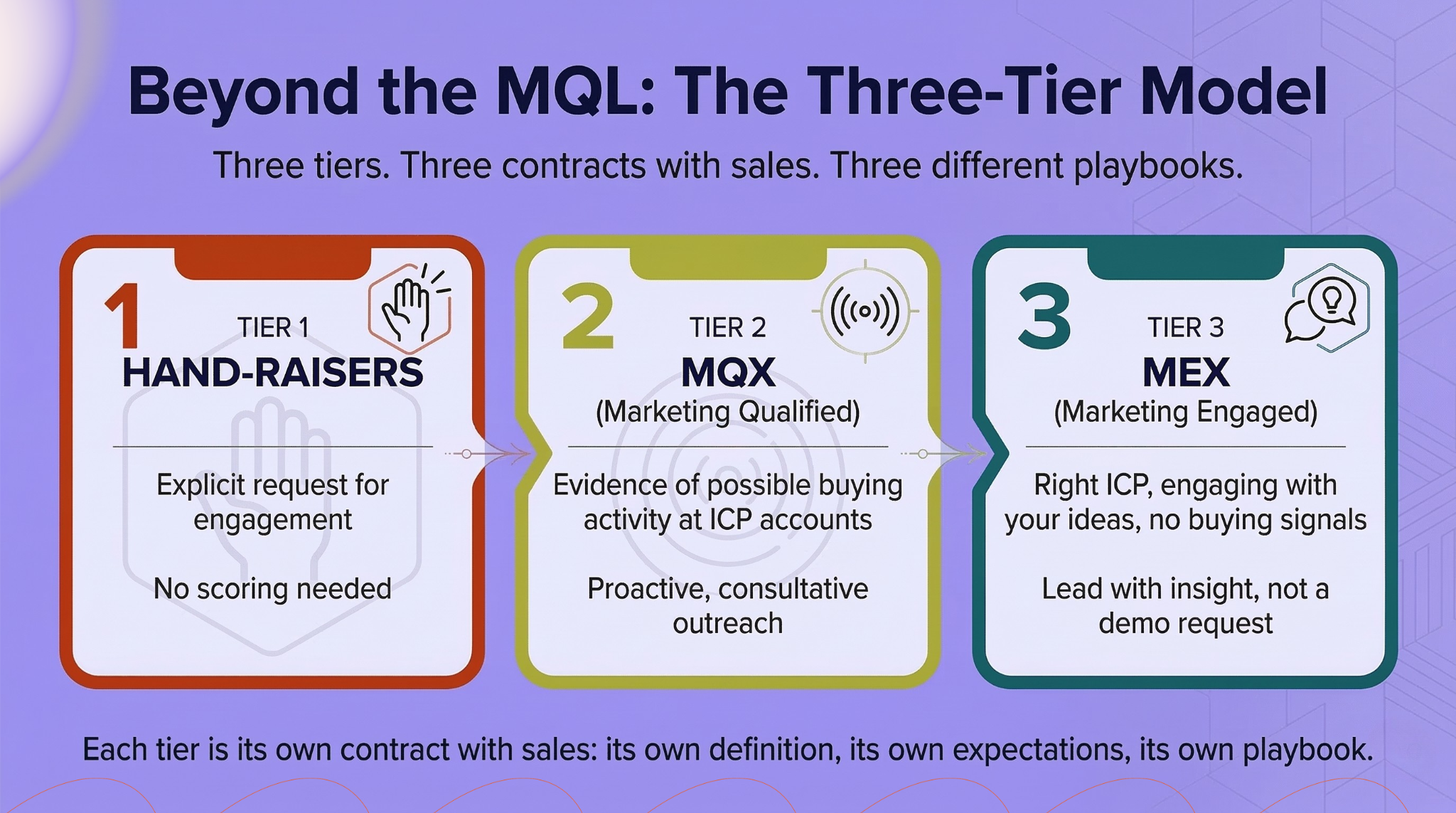
This article introduces a three-tier model that replaces one broken label with three honest contracts between marketing and sales:
Hand-Raisers are explicit requests for engagement. No scoring needed. Route immediately.
MQX (Marketing Qualified) represents marketing's evidence-based judgment that buying activity may be happening at an ICP account. These deserve proactive, consultative outreach with realistic conversion expectations communicated to sales.
MEX (Market Engaged) covers the right people at the right accounts who are engaging with your ideas but showing no buying signals. These people aren't qualified, but they're worth talking to, because helping buyers recognize latent pain is how you create demand, not just capture it.
The article also covers the expected value math behind why engaging at lower probability thresholds makes economic sense, why outreach quality is a variable in that equation (not a constant), what good latent-buyer outreach looks like drawing on Solution Selling and the Challenger Sale, and what metrics actually matter once you move beyond the MQL.