I've made public predictions about B2B go-to-market for four years, grading myself each time. (Here are the 2023, 2024, and 2025 editions, and my grades for 2025.)
This year was the hardest, since AI is making everything feel uncertain. As Nicolas de Kouchkovsky said, "2026 won't be predicted as much as navigated. The ground is shifting faster than teams can make confident forecasts".
But committing to specific predictions helps me navigate, even if I don't get them exactly right.
I hope these predictions help you navigate your year!
PS: This is just a summary of my full prediction article. The full 6,676 word article is hosted on the Chiefmartec blog: Jon Miller’s Predictions for B2B Go-To-Market in 2026. As Scott Brinker wrote: “I rarely publish guest posts on chiefmartec. This epic essay by Jon Miller — Predictions for B2B Go-To-Market in 2026 — was so good I made an exception….” I hope you’ll check out the full post.
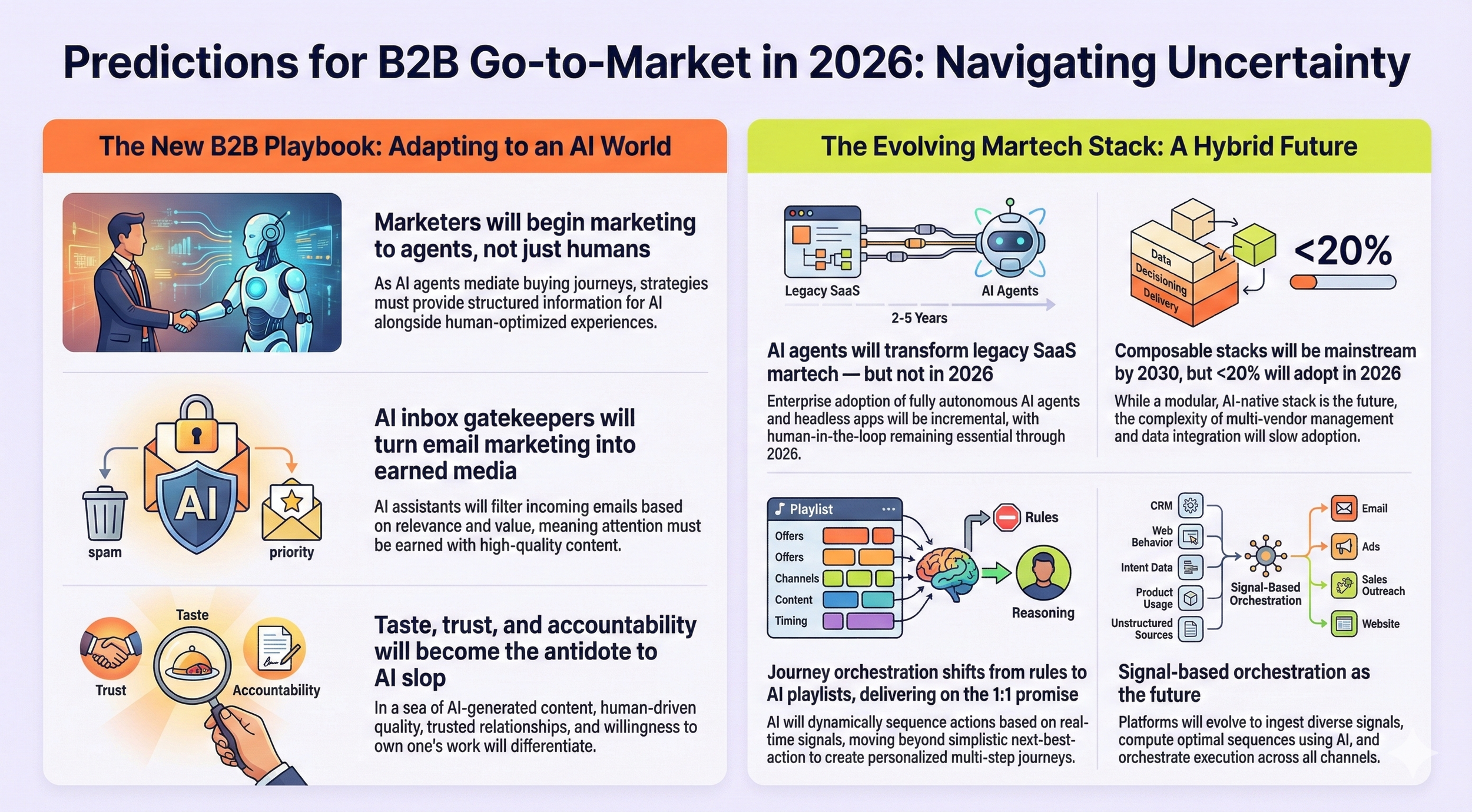
Marketers will begin marketing to agents, not just humans
As agents research and evaluate vendors alongside human stakeholders, we will start treating AI as a member of the buying committee.
We will see agent identification and tracking; teams will incorporate AI signals into scoring and buying stage predictions.
Agent visitors will contribute to Marketing Qualified Accounts (MQAs) just like human visitors. This will require a new capability: "agent deanonymization".
We will require a headless content architecture in which humans get branded experiences while agents get structured data and services.
Ultimately, efforts to optimize static content for AEO will prove unnecessary as AI gets better at reading human-optimized content.
AI will completely transform legacy SaaS martech — but not in 2026
If you spend any time on LinkedIn, you've seen the proclamation: "SaaS is dead."
AI is driving three disruptions to SaaS:
Autonomous agents replacing human labor
Headless applications replacing user interfaces (work through your chatbot instead of logging into platforms)
Vibe-coded mini-apps replacing simple tools
Prediction: These disruptions will reshape marketing technology — but over 2-5 years, not overnight.
2026 will see hybrid experimentation, not wholesale transformation, in which SaaS platforms (old and new) coexist with agentic AI, and human-in-the-loop will remain essential.
Why so slow?
Enterprises move cautiously — Martec's Law states that technology changes faster than organizations can absorb it.
SaaS platforms provide infrastructure that takes years to build right: compliance, governance, scalability, integrations; these challenges don't just disappear because of AI.
AI hallucinations persist, making independent operation risky for mission-critical activities.
Martech in 2026 won't look like autonomous agents running headless applications. It will look like SaaS with AI built in.
Think of it like self-driving cars: we're not getting full autonomy in 2026. We're getting advanced driver assistance where the human stays alert and in control, ready to take over.
Composable stacks will be mainstream by 2030, but <20% will adopt in 2026
The trend is towards composable martech stacks that let you choose the best tool for each job and avoid vendor lock-in.
And by 2030, modular, AI-native stacks will be the norm.
However, fewer than 20% of B2B teams will run fully composable architecture in 2026.
Some reasons:
Flexibility shifts complexity, it doesn't remove it.
Multi-vendor management requires operational maturity.
The idea of a central warehouse sounds great, but these platforms are typically built for engineers and analysts, not marketing needs.
Splitting decisioning (scoring, orchestration) from execution is harder than it sounds.
True orchestration requires deep campaign understanding (what offers exist, how they relate), control over execution to test and learn, and closed feedback loops. Current delivery channels, including legacy MAPs like Marketo, don't support this well.
So, most B2B companies won't leap to fully composable architecture overnight.
Instead, they will adopt "composable lite": data-first and decision-first, but not fully decoupled. The data warehouse is an important source of truth, but your MAP, etc. won’t be “dumb” execution channels.
Context engineering will emerge as a recognized practice across GTM teams
"Context engineering" is the discipline of capturing the operational knowledge that makes AI useful rather than generic.
It’s things like naming conventions, segment rules and the reasoning behind them, how to interpret the data schema.
This knowledge isn't formally captured. It lives in Slack threads and team members' heads. When your best MOPs person leaves, it walks out the door with them.
Legacy systems don’t help. They store data and outcomes, but not the reasoning behind decisions.
Teaching AI these skills looks like onboarding a new hire, except the knowledge becomes durable and reusable. Ops teams evolve from tactical ticket desks into the team strategically responsible for making AI actually useful.
Reasoning AI will begin replacing rules-based automation
Legacy marketing technology is built on rules engines. Those rules are brittle and can't handle the ambiguity that defines the real world.
Reasoning AI models can, which is why AI will begin replacing rules-based logic in marketing and revenue ops, starting with data management, lead scoring, and journey orchestration.
This addresses Justin Norris’ "messy middle": work too variable for rigid rules but not strategic enough for senior attention. The data cleanups, exception handling, Slack pings that bury ops teams.
Instead of configuring complex rule systems, ops teams will provide context: business goals, success metrics, guardrails, and data pipelines.
Journey orchestration shifts from rules to AI playlists, delivering on the 1:1 promise
The promise of 1:1 personalization has been unfulfilled in B2B for decades — but in 2026, early adopters will finally implement AI-powered journey orchestration.
Why now? Rules-based personalization devolves into unmanageable spaghetti diagrams, but reasoning AI can think through options to pick the best path.
Modern AI also handles B2B's complex behavioral signals, encoding engagement history and timing into rich representations that capture nuance.
True 1:1 means the right action: content, offer, channel, timing. You don't need unique content for everyone. Instagram proves this at scale — intelligently sequencing existing content into deeply personal feeds.
I call this "Playlists". Playlists adjust in real time based on engagement signals, creating billions of unique sequences without millions of custom assets.
More than “next best action”, Playlists create better journeys by looking several actions ahead, the same way a well-sequenced album works better than songs on shuffle.
In this model, humans create compelling offers and content, set boundaries and guardrails. Freed from complex workflow diagrams, they focus on understanding markets and crafting messages that resonate.
AI figures out who gets what and when across thousands of accounts, handling the combinatorial complexity and air traffic control to prevent message conflict.
AI inbox gatekeepers will turn email marketing into earned media
Marketers have treated email as "owned media": build a list, control when to send. That's breaking down.
As AI generates more messages (376 billion emails were sent daily in 2025, half unwelcome), buyers are deploying AI gatekeepers. Gmail summarizes deals, Yahoo replaces subject lines with AI summaries, Apple bundles promotional emails.
In 2026, email will shift from owned to earned media, where inbox attention is granted based on relevance, value, and trust.
The volume game is over. Send fewer emails with real value. Send from real people, not polished HTML blasts. Front-load key points for AI summarizers. Focus on engagement metrics: replies, meetings booked, opportunities created.
Taste, trust, and accountability will become the antidote to AI slop
AI made content creation nearly free, filling feeds with AI slop. In 2026, buyers will whitelist voices they trust, ignore the rest.
Taste is knowing what's worthwhile — discerning about quality and value. When anything can be generated instantly, evidence of “craftsmanship” is a value signal.
Trust is the relationships you've built over time. People trust people, not logos. Human emails outperform HTML, individual LinkedIn posts beat corporate accounts. Founder brands and executive influence become strategic. 75% of enterprise B2B companies will increase budgets for influencer relations in 2026 (Forrester).
Accountability is staking your reputation on what you share. Output is easy; the value is in standing behind it.
Public intent signals will commoditize; proprietary signals generate "alpha"
When every team has access to the same public signal data, it stops being an advantage.
Investors talk about "alpha", e.g. the extra return from information others don't have. For example:
First-party signals: demo requests, content engagement, trial signups, product tours. These signals tell you something no competitor can buy.
Unique combinations: Public signals may be commoditized individually, but how you mix them with your private signals creates an edge.
Timing: The value isn't just who to contact or what to say, but when. Signals that indicate the right moment have power that generic signals don't.
Where martech is heading beyond 2026
Three layers of signal-based orchestration:
Data layer: turns raw information into usable signals across CRM, product usage, behavior, third-party sources, etc. Includes account-level signals since much B2B buying happens anonymously.
Decisioning layer: computes multi-step Playlists, using AI agents that decide optimal offers, channels, and timing; personalize content; and determine what needs human review.
Delivery layer: executes via API, with channels retaining intelligence for domain-specific optimization. Decisioning orchestrates across channels; each channel optimizes within its domain.
Every vendor wants to own orchestration. I don’t know who wins; the battle will be messy, but will produce better platforms.
AI-driven disruption and global uncertainty will intensify through 2026
The World Uncertainty Index has spiked to levels dwarfing the 2008 financial crisis and early COVID. I find myself more worried about the world than I've been in my entire career.
While the uncertainty has multiple sources, AI-driven job displacement is a major driver — and the societal stakes are serious.
AI is already eliminating entry-level positions. A Stanford Digital Economy Lab study showed 16-20% employment decline in AI-exposed positions, concentrated among early-career workers.
Angelo Robles calls this "The Silent Freeze": companies maintain productivity without backfilling junior roles. If juniors aren't hired, they don't become seniors.
This won't stay entry-level. The Remote Labor Index measures AI's ability to accomplish complex projects — current models score 2%, but could reach 20% in 2026, moving job displacement up the skill ladder.
Governments and tech companies should mitigate displacement with policies like labor protections and training programs.
Otherwise, as Chris Penn writes, historically "when enough people have been displaced from work in a very short period, that's when things like pitchforks, torches, and guillotines tend to come out."
I don't have a simple playbook for what comes next. But standing still isn't an option. We must prepare for uncertainty.
Conclusion
Last year I said AI would ultimately make marketing more human. I still believe that.
This year’s predictions point toward AI taking on hard execution tasks: orchestrating playlists, reasoning through decisions, managing complexity at scale.
This will free humans to focus on understanding markets, crafting positioning that resonates, building relationships and experiences that can't be filtered or summarized.
The path is messier than I expected, and the job displacement ahead is real.
But the destination hasn't changed: AI handles the mechanics so humans can focus on judgment, creativity, and trust. That's the future I'm building toward.