THE ORIGINAL IDEA WAS SOUND
The Marketing Qualified Lead started as a contract between marketing and sales. Marketing would only pass leads when it had strong evidence that the lead was worthy of sales attention. That now was the right time to engage this person and their company. That they might be open to a sales conversation. In return, sales would commit to SLAs for timely follow-up. Marketing earned credibility by being selective; sales got higher-quality conversations.
But over time, the concept got bastardized. Under pressure to hit pipeline targets, marketing teams gamed scoring thresholds to inflate volume. Any responder to a campaign became an "MQL." Download an ebook? MQL. Attend a webinar? MQL. Hit an arbitrary point threshold that marketing could adjust to get whatever number it needed? MQL. The scoring became a lever for volume, not a filter for quality.
And so Sales started ignoring MQLs, or cherry-picking the obvious hand-raisers and discarding the rest. The original contract broke down, trust between marketing and sales eroded, and the "MQL is dead" movement was born.
THE OVERCORRECTION
A growing number of companies have responded by narrowing their focus almost exclusively to hand-raisers: demo requests, inbound inquiries, people who explicitly ask for sales contact.
I understand the appeal. Hand-raisers convert at higher rates, sales trusts them more, and nobody complains about lead quality when the buyer has already raised their hand. It feels disciplined.
But it also creates three problems.
It's too passive. You're ceding the initiative to buyers who may never recognize on their own that they have a problem worth solving. Some of the biggest opportunities come from helping buyers see a pain they hadn't prioritized.
It’s too late. According to the 6sense 2025 Buyer Experience Report, 94% of buyers put their shortlist in order of preference before talking to sellers, and 95% buy from their day 1 short list. By the time someone raises their hand, they've already formed preferences. You're competing for a spot on a shortlist that was built without you.
It forfeits the first-mover advantage. Mike Bosworth's Solution Selling research found that companies can win 90% of the time by engaging buyers while their pain is still latent and bringing them to an active evaluation. When you help a buyer recognize a problem they hadn't prioritized, you naturally become the vendor whose vision shapes the buying criteria. Waiting for hand-raisers means arriving after someone else has already set those criteria.
The answer isn't to go back to the old broken MQL model. It's to recognize that the binary framing (qualified or not, ready or not, pass to sales or don't) was always too simplistic for how B2B buying actually works.
INTEREST VERSUS INTENT
The key to solving the problem is to differentiate between interest and intent.
Interest is engagement with your content and brand. Someone reads your blog, attends your webinar, downloads your research. They find your ideas relevant to their work. That's valuable, but it doesn't mean they're buying anything.
Intent is signals of actual buying behavior. Someone visits your pricing page, downloads a competitive comparison, reads reviews on G2. Multiple people from the same account start engaging with solution-oriented content at the same time. The pattern matches what in-market accounts look like.
The MQL system collapsed because it conflated these two things. A webinar attendee and a pricing page visitor got the same label, the same routing, and the same expectations. No wonder sales lost trust.
What we need instead is a model with enough nuance to treat interest and intent as distinct signals, each valuable in its own way, each requiring a different response.
A NOTE ON LANGUAGE: MQX
Before going further, a note on terminology. B2B buying involves accounts and buying groups, not just individual leads. Some of the most important buying signals exist at the account level: multiple people engaging, third-party intent surges, technology adoption changes. A single person visiting your pricing page might be noise. Three people from the same account in the same week is a strong signal, even if no individual would have triggered it alone.
So rather than talking only about MQLs, I'll use MQX, where X can be Lead, Account, or Buying Group depending on your model. The principles in this framework apply regardless of which unit you track. But for most B2B companies, thinking at the account and buying group level will surface better signals than tracking individuals in isolation.
THE THREE TIERS
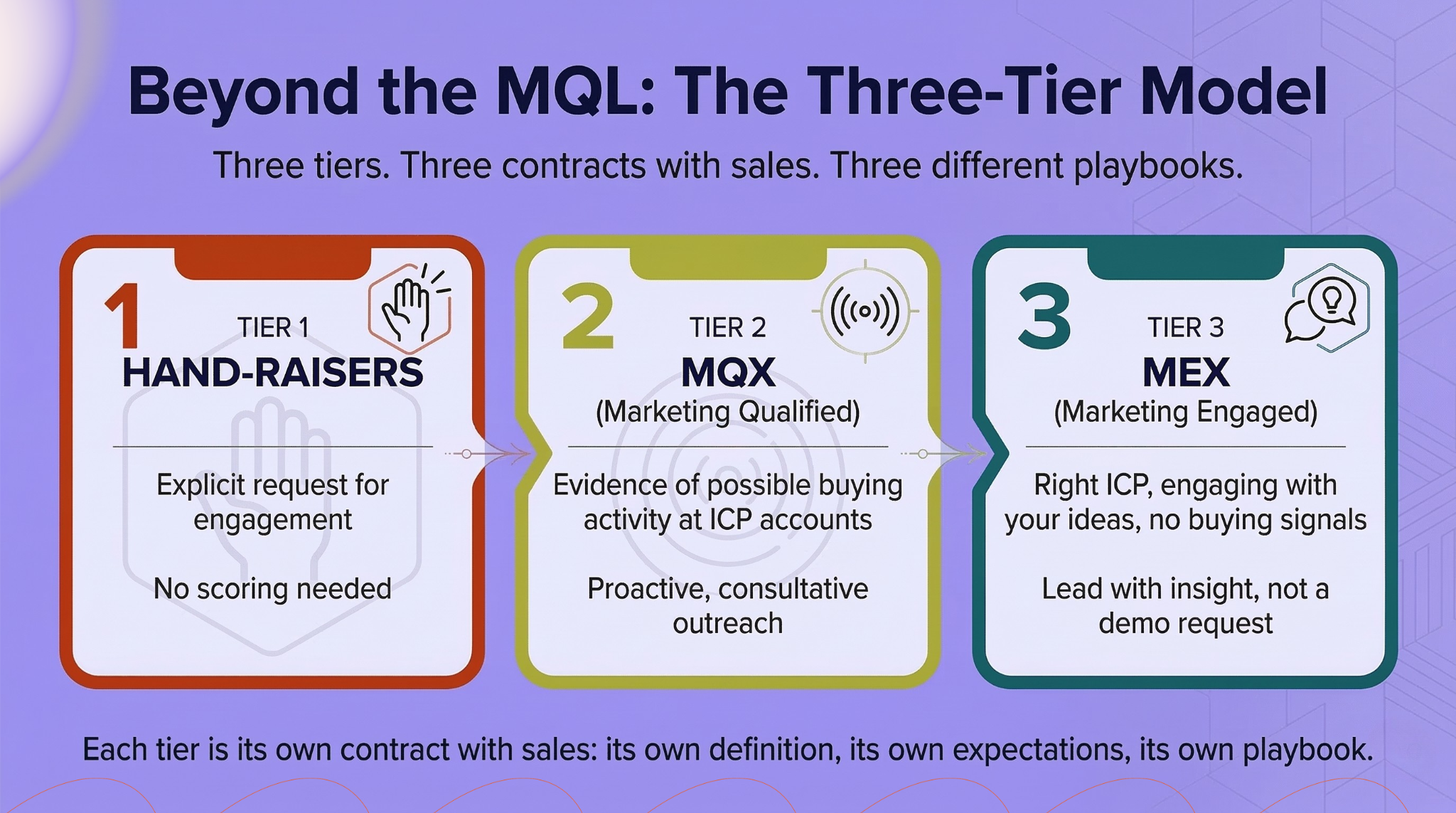
My approach has three categories, each has its own definition of what it means, its own expected conversion rate, and its own playbook for how sales should engage.
TIER 1: HAND-RAISERS
Demo requests, pricing inquiries, "contact me" forms, explicit requests for sales engagement. The buyer has removed all ambiguity. No scoring needed, no interpretation required. Route immediately, respond fast.
This is the clearest signal in B2B marketing, and it deserves its own category, separate from anything marketing "scores" or "qualifies." The buyer has done the qualifying for you.
TIER 2: MQX (MARKETING QUALIFIED LEAD / ACCOUNT / BUYING GROUP)
This is marketing's informed judgment, based on signal combinations, that there are meaningful indicators of in-market behavior. This is what the MQL was supposed to be before it got bastardized: an evidence-based assessment that an account or buying group may be in-market.
Signals that belong here: pricing page visits, competitor comparison downloads, review site activity, multiple people from the same account engaging with solution-oriented content, third-party intent data surges, and combinations of these signals that match patterns from past won deals.
The critical distinction: these signals suggest buying behavior, not just content consumption. Someone reading your blog about industry trends is interested. Someone reading your blog, then visiting your pricing page, then downloading a competitive comparison? That's a different pattern entirely.
Note that MQX does not mean "this person is definitely ready to buy." It means "marketing believes, based on data, that this account may be in-market." Sales needs to understand the expected conversion rate and adjust expectations accordingly. If the data says one in five MQXs converts to an opportunity, then four out of five not converting is the expected outcome, not a failure of marketing's scoring.
Also, as Kerry Cunningham points out, these are not technically "Qualified" in the way Sales uses that word. When a salesperson hears "qualified," they expect someone who's ready to engage in a buying conversation. Many MQXs won't be. They are simply more likely to be in-market than profiles without these signals. The whole point of this framework is to set honest expectations with Sales, and if the word "Qualified" resets those expectations back to "ready to buy," it's working against you. I stuck with Qualified here because the mental model is familiar and the framework is easier to adopt, but if the term carries too much baggage in your organization, consider calling this tier something like 'Marketing Recommended (MRX)' or 'Marketing Indicated (MIX)’.
TIER 3: MEX (MARKETING ENGAGED LEAD / ACCOUNT)
Right ICP firmographics, engaging with your brand and ideas (content downloads, webinar attendance, social engagement, event participation), but no buying signals. They're interested in the topic. They may even be interested in you. But they're not showing intent to purchase.
These are NOT qualified. Marketing is NOT saying "this account is in-market." Marketing IS saying: "This account fits our ICP and is engaging with our ideas. A consultative human touch could help them recognize a problem they might not yet see."
Bosworth's research found that only 5 to 10% of potential buyers are actively looking at any time. This aligns with the 95:5 rule of B2B: at any given moment, roughly 95% of your target market isn't in an active buying cycle. Those 95% are your future pipeline. Ignoring them means waiting for hand-raisers. Treating them like MQXs means burning trust with premature sales outreach. The right answer is a third category with its own purpose, its own approach, and its own expectations.
By the way, Kerry Cunningham also notes that putting "Marketing" in front of "Engaged" can trigger arguments about who gets credit for the engagement. That's not my goal here. The "Marketing" here describes whose systems tracked the engagement, whether that's with your own content or through third-party intent signals showing the account is researching your category elsewhere. If the label creates friction, "Market Engaged" (still MEX) shifts the emphasis from the department to the behavior.
WHY LATENT BUYERS DESERVE A HUMAN TOUCH
Human engagement with latent buyers isn't "nice to have nurturing." It's the mechanism by which the 95% move from latent pain to admitted pain to active buying. Without it, you're waiting and hoping.
Bosworth identified that the vast majority of potential buyers are living with problems they either don't recognize or have rationalized away as too expensive, too complicated, or too risky to address. He called this "latent pain." The seller's job at this stage is not to pitch a product. It's to help the buyer become aware of and admit their problems. As Bosworth put it: if buyers aren't aware they have problems that your products can solve, selling the problem is the first thing you have to do.
The Challenger Sale extends this: the best reps don't just uncover existing pain. They teach buyers about problems they haven't considered, reframing the buyer's worldview so the status quo feels riskier than change.
And the competitive advantage is significant. Bosworth found that companies who find opportunities in latent pain and bring them to an active evaluation win more than 90% of the time. That's because when you help a buyer see a problem they hadn't prioritized, you naturally set the buying criteria. You become Column A, in Bosworth's terminology, the vendor whose vision shapes how the buyer evaluates everyone else.
WHAT GOOD MEX (TIER 3) OUTREACH LOOKS LIKE
Lead with a reference story, not a pitch. Share what you're seeing across similar companies to stimulate recognition of pain: "I work with a number of [CMOs / VP Marketing Ops] in [industry], and what they're telling me is that their biggest challenge right now is [specific problem]. Some are finding that [specific consequence, with data if you have it]. I'm curious whether you're seeing something similar?" This demonstrates credibility, shares a relevant insight, and invites conversation without assuming anything about the buyer's readiness. Use the engagement context (the webinar they attended, the content they downloaded) to make the outreach warmer and more relevant. This is what separates MEX engagement from raw cold outbound.
Diagnose before you prescribe. Bosworth's three-part questioning model (open questions to understand the situation, control questions to guide toward specific issues, confirming questions to verify understanding) follows a clear sequence: diagnose the reasons for pain, explore the impact on the person and their company, then help the buyer visualize what a solution might look like. An SDR who skips the diagnosis and jumps to the solution is, as Bosworth put it, committing "sales malpractice."
Help the buyer quantify the cost of the status quo. Latent pain stays latent because the buyer hasn't calculated what the problem is actually costing them. Help them do that math: "If your team is spending X hours per week on [process], at a fully-loaded cost of $Y per hour, that's $Z per year before you count the opportunity cost." When buyers see the number, latent pain can quickly become admitted pain.
Create hope, not pressure. Buyers move from latent pain to active buying when they can imagine a better future state. Paint a picture of what's possible: "Companies that have addressed this are seeing [specific outcome]. Happy to share what's working if that would be useful." The goal is curiosity and hope, not urgency and fear.
THE ECONOMICS: WHY THE MATH SUPPORTS ENGAGING EARLIER
The argument for engaging latent buyers rests on sales methodology and competitive advantage. But there's also a straightforward economic case, drawn from decision theory, for engaging at lower probability thresholds than most companies use today.
The core principle: you should reach out when the expected value of engaging exceeds the expected value of doing nothing.
Engage when: P(in-market) > Cost_FP / (Cost_FP + Cost_FN)
Where:
P(in-market) = estimated probability this account is actively buying
Cost_FP = cost of a false positive (reaching out to someone who isn't in-market)
Cost_FN = cost of a false negative (missing someone who IS in-market), calculated as deal value × win probability if you'd engaged at the right time
A WORKED EXAMPLE
Say your average deal is $100K ACV and your win rate on in-market opportunities is 20%. The cost of missing an in-market buyer (false negative) is $20,000 in expected value.
Now consider the cost of a false positive. The direct cost is easy to calculate: fully-loaded SDR time for a wasted outreach is maybe $200. But the hidden costs are larger than most people realize:
Deliverability and list damage: If even 5% of recipients hit the spam button after a bad outreach, you don't just lose them. You damage your sender reputation and hurt deliverability to everyone else on your list. A bad sales touch can also cause someone to unsubscribe from marketing entirely, cutting off the nurturing relationship that might have converted them months or years later. These compounding costs dwarf the cost of any single outreach.
Negative word of mouth: Senior buyers talk to each other. A CMO who gets a tone-deaf "saw you downloaded our ebook, want a demo?" message will mention it at the next peer dinner, in their Slack community, or in a LinkedIn comment. That kind of reputation damage is hard to quantify but very real.
Brand categorization: Once you're mentally filed as "one of those vendors that calls when you download something," it's very hard to climb back out of that box.
Let's take these hidden costs seriously. A realistic estimate for the total cost of a false positive (including brand damage, deliverability degradation, and lost future marketing access) might be $2,000 or more for an enterprise B2B company with a high-value audience.
Optimal threshold = $2,000 / ($2,000 + $20,000) ≈ 9%
So, with these estimates, the math says that if there's roughly a 10% chance an account is in-market, the expected value of engaging is positive.
Now consider what your scoring can do. If only 5% of your total addressable market is in-market at any given time (the 95:5 rule), and your signals can identify accounts that are three to four times more likely than the base rate to be buying, those accounts are at 15-20% probability. Traditional MQL thinking would say "not enough evidence, keep nurturing." The expected value math says you should engage.
OUTREACH QUALITY CHANGES THE MATH
There's an important variable in this equation that's easy to overlook: the false positive cost is not fixed. It's a function of outreach quality.
Bad outreach (generic pitches, "saw you downloaded our ebook, do you want a demo" emails, obvious AI slop) drives false positive costs up through opt-outs, brand damage, and negative word of mouth. This is what poisoned the MQL well in the first place.
Good outreach (genuine insight, substantive value, consultative perspective) drives false positive costs down. If a non-buyer receives a thoughtful message that helps them think about their business differently, the "cost" might actually be negative: you've built goodwill and brand affinity that compounds over time.
So the expected value math doesn't just support engaging more broadly. It demands that you engage more thoughtfully. You can lower the engagement threshold, but only if you raise the quality of the engagement. The two go hand in hand.
WHY TIER 2 AND TIER 3 ARE DISTINCT
The economics suggest that both MQXs and MEXs can justify human engagement. And the approach may look similar on the surface: consultative, insight-led, value-driven. So why maintain two separate tiers?
Because the framing and the goal differ, and that affects how sales should think about each conversation.
For MQXs (Tier 2), there's reason to believe buying activity may be underway. The goal is to get into an active evaluation. The conversation might reference the buying context: "We're seeing a lot of companies in your space looking at solutions for [problem]. I'd love to understand what you're seeing." Some percentage of these will convert to active opportunities on a reasonable timeline.
For MEXs (Tier 3), there's no evidence of active buying. The goal is to help the buyer recognize a latent pain and potentially start a buying journey that didn't previously exist. This is demand creation, not demand capture. The conversation is about the problem, not the solution. Conversion will take longer and the immediate hit rate will be lower, but the positional advantage is substantial.
The distinction also matters for setting realistic expectations with sales. If you route both categories under the same label, sales will expect similar conversion rates. When Tier 3 contacts don't convert at the same pace, the familiar trust erosion cycle begins. By separating them, you can set explicit expectations: "MQXs convert to opportunity at roughly X%. MEXs convert at a lower rate over a longer timeframe, but when they do convert, we're almost always the preferred vendor."
WHAT TO ACTUALLY MEASURE
The three tiers are useful as leading indicators. They help you understand the health of your pipeline creation process:
Are we generating enough hand-raisers?
Are we identifying enough accounts with meaningful in-market signals?
Are we building enough engagement across our ICP to create future pipeline?
But they are not success metrics in their own right. None of them equate directly to revenue. An MQX that doesn't become an opportunity is activity, not outcome.
The metrics that actually matter:
Total pipeline created: Is there enough pipeline, across all sources, to meet revenue goals? This is the number the business cares about.
Total revenue: The ultimate shared metric across GTM.
Marketing efficiency: Total pipeline divided by total marketing investment. This tells you whether your engine is healthy and whether you're getting better or worse over time.
The three tiers are the dials you turn to influence those outcomes. Track them, optimize them, set targets for each. But always in service of pipeline, revenue, and efficiency.
PUTTING IT TOGETHER
The MQL started as a contract between marketing and sales. The three-tier model restores that idea, but with more honesty. Each tier functions as its own agreement: its own definition, its own expected conversion rate, its own rules for engagement. Hand-Raisers get immediate response. MQXs get proactive, consultative outreach with realistic expectations communicated to sales. MEXs get value-driven human engagement designed to surface latent pain and start buying journeys that wouldn't have happened otherwise.
A practical first step: audit what you're currently sending to sales. How many are genuine hand-raisers? How many show real buying signals? How many are simply engaged? Most companies have never separated these, which means they've never set the right expectations for each. That separation alone can start rebuilding the contract that broke.
And I'd argue the key to making all of it work is a principle as old as Solution Selling itself: bring value to the buyer at every stage, whether they're buying today or not. Do that consistently, and the pipeline takes care of itself.